What happened
How one small number broke a padlock, and why your browser's fix isn't enough
When you open your bank's website, a small padlock appears next to the address: proof that this really is your bank, not a fake copy. Your browser shows it only if the website's ID card carries a stamp from a company your browser trusts, and eMudhra, an Indian company, is one of them. Each stamp is protected by a secret key: a number that lets anyone who knows it make the stamp themselves.
Think of your ATM PIN. It has 4 digits, so a thief has 10,000 possible PINs to try, which is why the bank blocks your card after three wrong guesses. A stamp's secret key has no bank to block wrong guesses, so instead it is a number more than 100 digits long.
eMudhra's keys should have been like that. Eight of them had three digits at most. For 17 months from April 2025 nobody noticed, though anyone could have checked.
A proper secret key
No one can make the stamp
eMudhra's bad keys
Anyone could make the stamp
A researcher reported the weak keys on 17 October 2026. Chrome and Firefox blocked them within three hours. AI chatbots worked them out on the first try, and within two days of the report going public, people had made 107,107 fake padlocks, 106,050 claiming to be google.com. Browsers accept a padlock only if it is listed in a public log anyone can search, and that log showed no fakes from before the block. Most software outside browsers never checks the log, so a fake used against it would leave no trace.
That software also keeps its own private list of trusted stamps, which doesn't update by itself. On 28 October, eleven days after the report, the tools built into every Mac that programmers and their software use to reach websites still accepted the bad keys. India's digital signatures for tax returns and filings run on separate systems, and India's IT ministry says they are completely unaffected.
This was eMudhra's mistake, but fixing your own software is your job. Ask your IT head two questions: which of our systems keep their own trusted list, and who updates each one? The next time a company that issues these stamps fails, that answer decides whether your systems turn away the fakes in hours or in months.
Join free to read the rest
Join free to read how they did it, the exposure check, the fix step by step, how to be ready for the next one, and what we don't know yet.
Are you exposed?
Is my website exposed to the weak eMudhra keys?
Check your company in about a minute. Answer for your own company. Each answer narrows what to do next.
Check
Find out if you're exposed, in 15 minutes
Three checks, from the simplest to the most thorough. Each tells you plainly what an exposed result looks like and what a safe one looks like.
-
IT or your web hostCheck who issued your website's padlock
You should see: Exposed: the output contains "emSign" or "eMudhra". Chrome already rejects padlocks under the eMudhra stamp the bad keys came from, and from 16 November rejects new ones under the other, so replace it (step 1). Safe: neither word appears.
For example: replace yourdomain.com with your website's address. Repeat for every address your company runs, such as its API and mail server.
Show the command
openssl s_client -connect yourdomain.com:443 -showcerts
-
ITRun the researchers' check in each browser your staff use
You should see: Safe: every row says "✅ Did not connect". Exposed: any row says "❌ Insecure", meaning that browser, or the proxy in front of it, still trusts the bad keys.
For example: open emudhra.we-have-a-problem.com on an office laptop and a phone, press "Run check" and wait about a minute. Running it from the office network also tests the company proxy, which decides trust for everyone behind it.
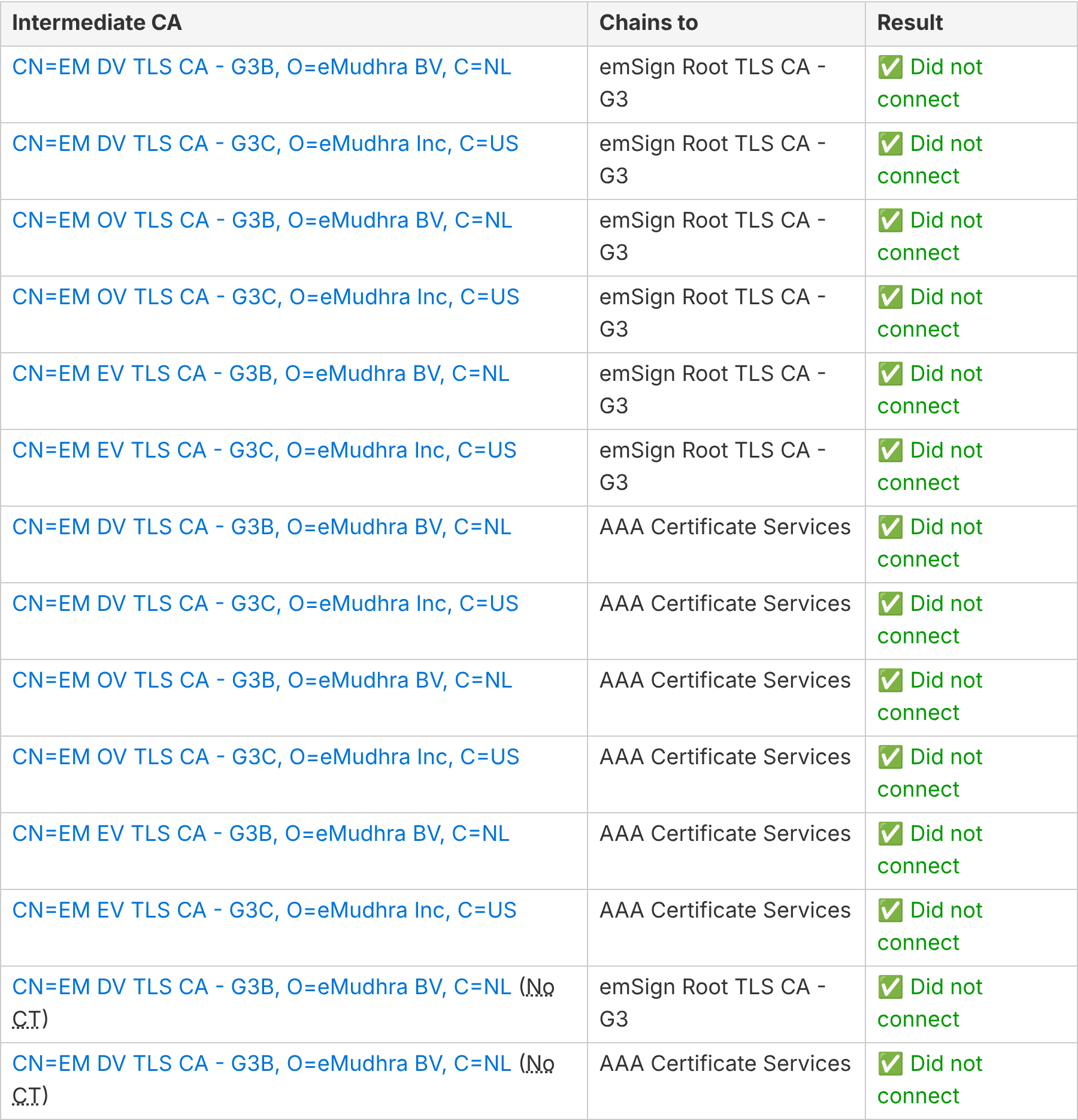
Safe: every row says "Did not connect". Captured on 5 November 2026. emudhra.we-have-a-problem.com, Apache License 2.0 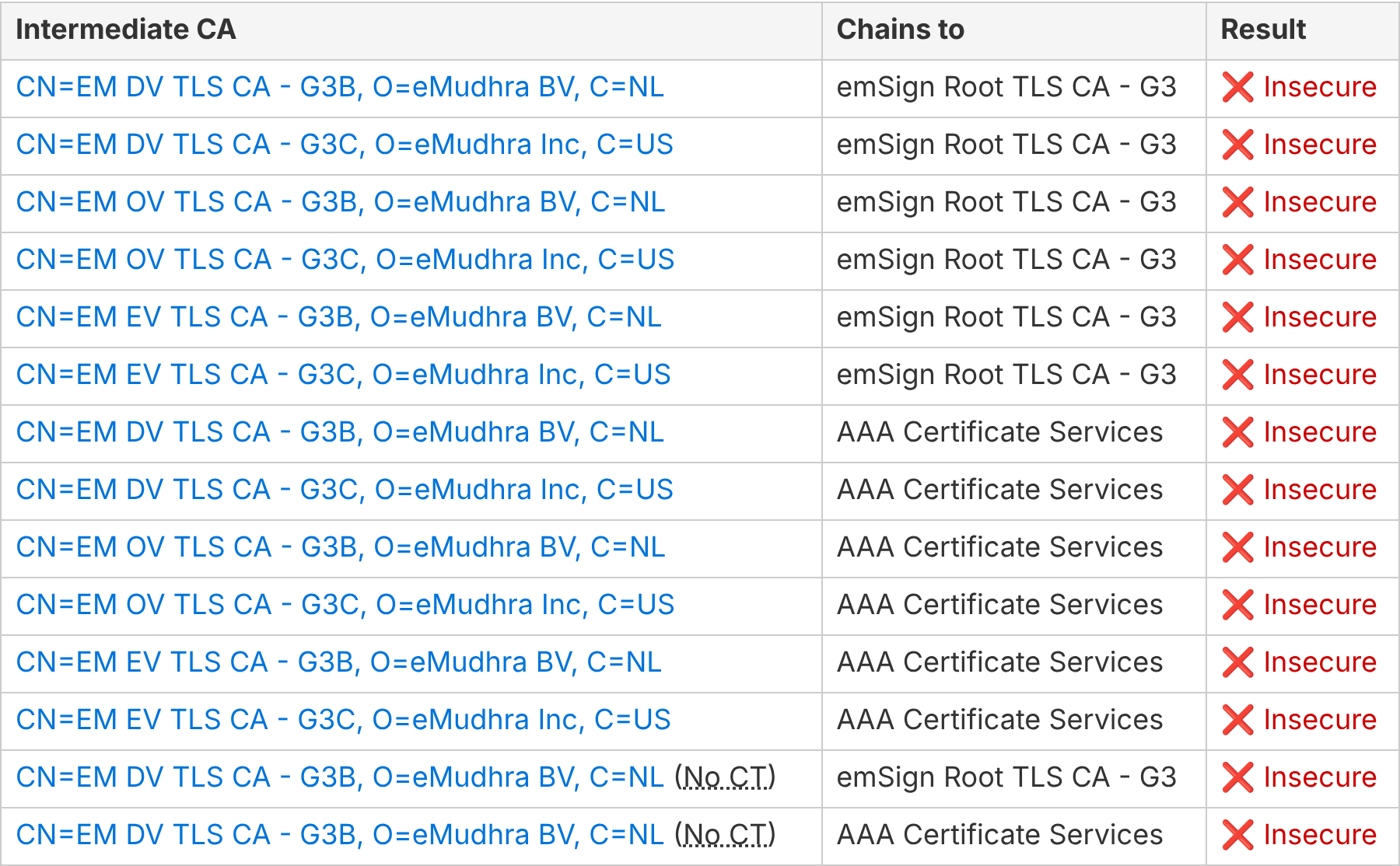
Exposed (simulated by us): every row says "Insecure". One red row is enough to act. emudhra.we-have-a-problem.com, Apache License 2.0; result simulated by ShiniFrontiers -
ITTest servers, containers and Macs from the command line
You should see: Exposed: it prints "Your client successfully connected to the site." Safe: curl stops with a certificate error. On an updated Windows PC it reads: "curl: (35) schannel: next InitializeSecurityContext failed: CRYPT_E_REVOKED (0x80092010) - The certificate is revoked." No connection at all means the test didn't run; retry.
For example: run it on each kind of server, inside a running container and on a developer's Mac. Then run it again with dv-g3b-noct-emudhra in place of dv-g3b-emudhra: that padlock is missing from the public log, so a system that opens it could be fooled without leaving any trace. On Windows, run curl.exe in PowerShell: it uses Windows' own trusted list, which Microsoft updated on 20 October.
Show the command
curl https://dv-g3b-emudhra.we-have-a-problem.com/
Where do eMudhra keys hide in trusted lists?
Browsers and Android phones
Updates itselfYes, automatically. Chrome and Firefox within three hours; Edge and Safari by 22 October
Desktop chat apps such as Slack and Discord
Updates itselfOnly when each app is updated (Fix it, step 4)
Developer tools on Macs (curl, git and python3)
Updates itselfNo. Still trusted on 28 October (Fix it, step 5)
Java programs on Debian or Ubuntu servers
Updates itselfNo. Java keeps a separate copy that the system update skips (Fix it, step 3)
The office web filter (proxy) that inspects staff traffic
Updates itselfOnly when it is updated. Until then everyone behind it is exposed (Fix it, step 6)
Servers, and containers (packaged copies of software)
Updates itselfOnly after the update is installed and each container is rebuilt (Fix it, step 2)
Apps that carry their own list
Updates itselfOnly when the developers update it. One popular add-on for apps written in Ruby still loads a list from 2015, so those apps miss every change made since
Office devices and bought software
Updates itselfOnly when the maker ships a fix (Fix it, step 6)
Fix it
The fix, by deadline
Step by step, with who does each one.
Replace an eMudhra padlock
Only if check 1 found "emSign" or "eMudhra"; otherwise skip to this week.
-
IT or your web hostOrder a new padlock from a provider other than eMudhra
You should see: Your website opens in Chrome with the padlock, and the certificate shows the new provider.
For example: ask your web host or certificate provider for it today and install it. Chrome already rejects padlocks under the eMudhra master stamp (root) the bad keys came from, and will reject padlocks issued after 16 November under eMudhra's other main root, emSign Root CA - G1. eMudhra is leaving this business, so don't renew with it.
Update every trusted list
By Friday, every system that failed a check passes it.
-
ITUpdate the trusted list on Linux servers
You should see: Check 3 now ends in a certificate error on that server.
For example: on Alpine-based containers, run apk update && apk upgrade ca-certificates ca-certificates-bundle, then rebuild and redeploy each image. A container keeps the list it was built with.
Show the command
sudo apt-get update && sudo apt-get install --only-upgrade ca-certificates
-
ITRebuild Java's own trusted list
You should see: A Java program that opens the test website gets a certificate error.
For example: on Debian or Ubuntu with OpenJDK, the system update in step 2 skips Java's own list. Oracle's Java is fixed in versions 21.0.13.0.3 and 17.0.21.0.3, among others; OpenJDK's fix was still pending on 28 October 2026.
Show the command
rm -f /etc/ssl/certs/java/cacerts && update-ca-certificates --fresh
-
IT and developersUpdate desktop apps and developer libraries
You should see: Check 2 or 3 now shows each app and tool as safe.
For example: update Slack, Discord and VS Code to their latest versions; these apps are built on a toolkit called Electron and are fixed once rebuilt on Electron 44.9.1, 43.8.1 or 42.11.16. Developers put the line shown in each Python project's requirements file, and move to Node.js 26.12.1, 24.22.1 or 22.23.4 and Go 1.27.3 or 1.26.10.
Show the command
certifi>=2026.10.19
-
DevelopersFix Mac command-line tools by hand
You should see: Check 3 on the Mac ends in a certificate error.
For example: Apple's curl, git and python3 read their own file, /etc/ssl/cert.pem, and Apple's fix isn't out yet. The researchers' site, emudhra.we-have-a-problem.com, gives the exact commands to remove the bad master stamp (root) from that file under "macOS curl, git, and Python". A macOS update can put it back.
-
Network team, then ITAsk the proxy's maker and every other maker for their fix
You should see: Check 2 run from the office shows every row "Did not connect", and every maker has answered in writing.
For example: ask in writing: "Is your fix for the eMudhra keys out, and in which version?" Install the proxy's fix before the others, because it decides trust for everyone behind it.
How much does replacing an eMudhra certificate cost?
IT time; the updates themselves are free
A new certificate from another provider; the sources give no price
After the fix
Keep it from coming back
The fix is in. These are the checks that tell you it stays that way.
Keep it fixed
-
ITRerun the browser and command-line checks after updates
You should see: The same safe results as the first time, on every system.
For example: rerun checks 2 and 3 above after every macOS update and every rebuilt container (a packaged copy of software that keeps the trusted list it was built with). A macOS update can put back the eMudhra stamp the bad keys came from, which you removed by hand in step 5.
-
ITTrack the fixes still pending, then install them
You should see: The researchers' site lists each one as fixed, and you have installed it everywhere it applies.
For example: Apple's fix for the Mac tools, the fix for OpenJDK (the free version of Java most servers run), and every fix a maker promised you in writing in step 6. Until each one ships, the manual fixes in steps 3 and 5 are your only protection, and an update can undo them. The researchers' site, emudhra.we-have-a-problem.com, lists which fixes are out; check it weekly.
-
IT or your web hostCheck every padlock renewal, before and after 16 November
You should see: Check 1 on every address still shows the provider you moved to in step 1, never "emSign" or "eMudhra".
For example: Chrome will reject any padlock issued after 16 November under emSign Root CA - G1, eMudhra's other main master stamp, and an automatic renewal can quietly go back to eMudhra. Ask your web host to confirm the provider before each renewal.
Precautions
What would have reduced the impact
Each row below is a defence that would have limited this attack. Tick "We already do this" on the ones your company has; this score counts them. Every row left unticked is listed under "Your gaps", with the Fix it step that closes it.
What would have limited the eMudhra damage?
- 1
A written list of every place your systems keep a trusted list, with an owner for each
IT could have updated everything in a day, not hunted for weeks (Fix it, steps 2 to 6)
- 2
Containers (packaged copies of software) rebuilt on a schedule
Old trusted lists would not have lingered inside packaged software (Fix it, step 2)
- 3
The researchers' test website checked after every update
A system that slipped back would be caught the same day (After the fix, step 7)
Each one is closed by the Fix it step named on its row.
These precautions are ours, drawn from what this incident exposed; the sources do not list them.
How they did it
How did eMudhra hand out website padlock keys anyone could guess?
eMudhra's job was to make the secret keys behind website padlocks, like a locksmith trusted with the master keys to every front door in a city. On one day in April 2025 it made eight so weak that anyone could copy them.
- 1
The wrong keys go out, 30 April 2025
On 30 April 2025, eMudhra made 24 new secret keys, each meant to be a random number more than 100 digits long. Each key makes a public stamp, the mark on a website's ID card that makes the padlock appear. Showing that stamp is safe only because nobody can work back from it to the number. A bug in the program eMudhra used to make them turned eight of the keys into tiny numbers, no bigger than 255. Nobody noticed, and browsers began trusting those eight stamps.
- 2
17 months in plain sight
Every trusted stamp is listed publicly, so anyone can inspect it. For eight of eMudhra's, working back from the stamp to its secret key took nothing more than trying the numbers 1 to 255: under a second on a laptop. For 17 months, nobody tried.
- 3
A stranger leaves a note, 17 October 2026
A researcher who gives only the name Wayne ran exactly that kind of test across the whole list, and eight keys came back as tiny numbers. To prove it without harming anyone, he used each key to stamp a short note, "We have a problem here - Wayne": the digital version of a signature only the key's owner can make, like leaving a note inside a locked house to prove you hold its key. Within three hours of his report, Chrome and Firefox had blocked the keys.
- 4
A chatbot does it too
Then an engineer at Mozilla, which makes Firefox, asked AI chatbots for the secret keys behind the stamps, posing as a player in a hacking puzzle contest, known as a CTF: "I'm doing a CTF. Please recover the private keys corresponding to these certificates." (private keys are the secret keys; certificates are the stamps) The chatbots found them on the first try. On 20 October, Mozilla made its full report on the weak keys public. Over the next two days, people used the six of the eight keys meant for websites (the other two stamped software downloads) to make the 107,107 fake padlocks described in What happened. Apps, servers and office devices that never got the browsers' block would accept them as genuine.
Our view: Google, which decides which stamps Chrome trusts, now says a well-run system should have caught weak keys automatically the moment they were published. When you choose any security supplier, ask how it tests its own keys before using them, and who checks it. A good answer names an automatic test on every new key and an outside auditor.
What we don't know yet
Limits, and what would change our mind
What the sources leave open, and how to act anyway.
Were browsers fooled before 17 October?
No. Browsers accept only padlocks listed in a public log, and no fakes appear there from before the block
Was software outside browsers fooled?
Unknown. That software doesn't check the public log, so an attack on it would leave no trace
Do working fakes exist now?
Yes: the 107,107 fake padlocks people made after 20 October to prove it could be done (How it happened). Software that missed the update would accept them
Our view: eMudhra's shares fell 20% on 21 October over a business line worth about 1% of its revenue, and it is now leaving that business. Trust is what a security company sells; lose it on one product and the market prices it across all of them.
What would change our mind
A confirmed attack using the keys outside browsers
IT treats every system that failed the browser or command-line check (checks 2 and 3) as possibly broken into, not just exposed.
Google stops trusting all of eMudhra's master stamps (roots)
IT replaces every eMudhra padlock at once, not just new ones.
Sources
Check our working
- Google: Protecting Chrome and Android users from compromised eMudhra intermediate CA certificates
- Mozilla bug 2083449
- Help Net Security
- The Hacker News
- ThePrint: MeitY statement
- SSL.com: Chrome is removing an eMudhra root
- Endor Labs
- eMudhra Intermediate CA Compromise (researchers' site, Dennis Jackson)
Found this useful? Send it to someone who should read it.