What happened
How the attackers got in
Ivanti Connect Secure is a VPN server: staff open its login page from home, type a password and reach the company network. The login page has to be open to anyone on the internet, or staff could not reach it. Behind it, the same server runs programs only signed-in staff may use — one of them accepts file uploads.
Every request to the server carries two things: the web address it is going to, and a separate note naming the program that should handle it. The server decided whether to let a request in by reading the address, and where to send it by reading the note. It never checked that the two matched.
A member of staff
Sees the login page
The attacker
Reaches a staff-only program, no password
So the attackers sent requests addressed to the public login page, with a note saying "give this to the upload program". The server let them in as login visitors and handed them to the upload program as if they came from signed-in staff.
They uploaded a program of their own, disguised as a ZIP file. The server saved it, saw it was not a real ZIP and deleted it — but for a split second it sat there, and one of a flood of requests to run it landed in that moment. A third flaw then gave them full control of the server, and their code deleted the log entries that would show it.
With full control, they used the VPN server's own login to the company directory to search for administrator passwords and the keys that unlock encrypted disks, and read logins passing through. The update closes the way in. It does not change a single password they copied, and Ivanti's check tool, which looks for changed files, may find nothing.
Why now
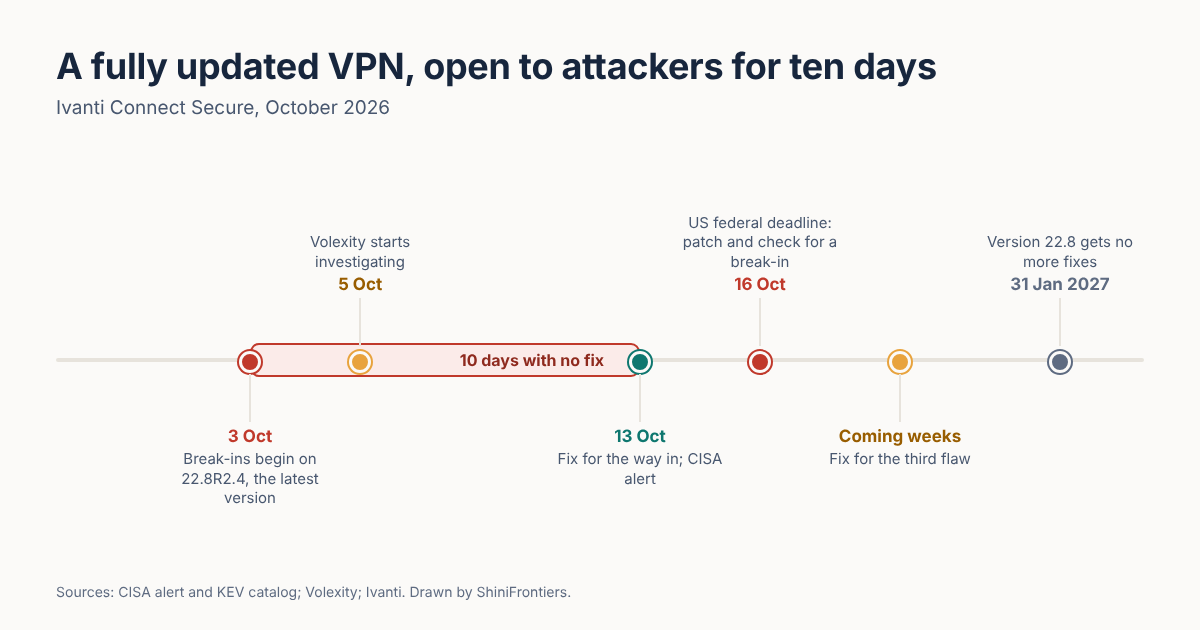
It is not alone: Ivanti's own October review lists attacked flaws in Citrix NetScaler and FortiMail in the same weeks. The devices at a company's edge are where attackers are aiming. CISA gave US federal agencies three days, to 16 October, and told them to check for a break-in, not just patch.
The bug is fixed; the lesson is not. A front door that trusts a hidden note, holds keys to the whole building and keeps its only logbook on itself will be broken into again. Fix that before the next one.
Join free to read the rest
Join free to read how they did it, the exposure check, the fix step by step, how to be ready for the next one, and what we don't know yet.
Are you exposed?
Am I exposed to the Ivanti Connect Secure break-in?
Find your path in four questions. Answer for your own company. Each answer narrows what to do next.
Affected if
This alertYou run Ivanti Connect Secure 25.1.1.1, 25.1.2.2, 22.8R2.4 or earlier
Who acts
This alertIT updates and rebuilds; security runs or buys the forensics; the CEO approves the downtime and the company-wide reset
Not affected if
This alertYou do not run Ivanti Connect Secure — the alert names no other product
Fix it
The fix, by deadline
Step by step, with who does each one.
Shut the door
CISA lists this flaw in its Known Exploited Vulnerabilities catalog — proof it is being used in real attacks — and gave US federal agencies three days, until 16 October, to act.
-
ITList every Ivanti Connect Secure server and its version
For example: include virtual machines and cloud copies as well as hardware — each one needs the update.
-
ITUpdate each VPN server to a fixed version
You should see: Each VPN server reports one of the fixed versions.
For example: a server on 22.8R2.4 goes to 22.8R2.5 tonight; Ivanti's 25.x Upgrade and Migration Compatibility Guide covers hardware and virtual servers. The fixed versions are 25.1.1.2, 25.1.3.0, 25.1.3.1 and 22.8R2.5.
-
securityLook for the attack in your network logs
For example: many requests to the login page within seconds, each with an X-DSCGI-PATH line pointing somewhere else — the pattern shown above. Any mismatch between the address and that line is worth a look.
-
securityCheck the VPN server for leftovers, and for connections it should not make
For example: the VPN server trying to sign in to a file server is a warning sign. Volexity advises checking its /tmp/ folder and investigating any such attempt.
Prove it is clean, or rebuild and reset
Ivanti's check tool cannot settle this. Either network and memory forensics show the VPN server was never broken into, or CISA advises treating it as broken into and following its recovery steps.
-
ITBack up the VPN server's settings
For example: save the settings to your archiving server, following Ivanti's guide How to Backup & Restore the Binary Configuration Using Archiving Server.
-
ITDo a factory reset on the VPN server and upgrade it to the latest version
You should see: A clean VPN server, on the latest version, that nobody has touched since.
For example: a hardware server is wiped and reinstalled; a virtual or cloud server is replaced by a fresh instance on the latest version.
-
ITRestore the settings from the backup
For example: the same staff sign-in rules and connections come back, on a VPN server that is now clean.
-
IT, with securityReset the passwords of every account — directory, administrator and local
For example: start with the account the VPN server uses to talk to the company directory — the attacker used it.
-
ITReplace the certificates, API keys and licence-server logins the VPN server stored
For example: the certificate staff devices use to trust the VPN is revoked and reissued; the API keys and licence-server credentials are reset.
-
security, with the incident responderAsk whether to change the disk-unlock keys too
For example: a stolen laptop is only protected if its BitLocker recovery key — the key that unlocks its encrypted disk — is not in the attacker's hands. The attacker searched for these keys; CISA's list does not name them, so decide with whoever runs your forensics.
Leave version 22.8
-
ITInstall Ivanti's fix for the third flaw when it ships
For example: set a weekly reminder to check Ivanti's security advisory; on 13 October Ivanti said the fix would come in the coming weeks.
-
IT, with budget from the CEOMove every VPN server off version 22.8 to 25.x
For example: put the upgrade in this quarter's budget, not January's. Version 22.8 gets no more fixes after 31 January 2027; Ivanti recommends moving to 25.x as soon as possible.
How much does fixing Ivanti Connect Secure cost?
Not stated in the sources — IT time per server
Remote access is down while it is reset, upgraded and restored
IT time, and every member of staff sets a new password; certificates and keys reissued
An outside incident-response firm if you lack the skills; the sources give no price
Precautions
What would have reduced the impact
No update could have stopped this: the flaws were unknown until Ivanti fixed them on 13 October. What a company controls is how fast it notices, and how much one break-in can reach. This company noticed fast: it was a customer of Volexity's network monitoring, and the investigation began on 5 October — two days after the first break-in.
Treat the VPN server as the most exposed machine you own, because it is: every attacker on the internet can reach it, and it holds keys to everything behind it. Plan as if it will be broken into again — give it small keys, loud alarms and a log it cannot erase — and the next zero-day becomes a bad week instead of a breach.
Each row below is a defence that would have limited this attack. Tick "We already do this" on the ones your company has; this score counts them. Every row left unticked is listed under "Your gaps", with the Fix it step that closes it.
What would have caught the Ivanti Connect Secure break-in early?
- 1
The VPN server reaching into the network — watched around the clock by security or a monitoring provider
The VPN server signing in to the company directory, searching it and trying passwords against staff accounts — the sign Volexity names first
- 2
Odd requests to the login page — security
Many requests within seconds, each with a hidden note naming another program
- 3
A warning before the public alert — security, through a threat-intelligence feed
Volexity's threat-intelligence customers had the attack's fingerprints on 10 October, three days before CISA's alert
What would have limited the damage
- 1
Give the VPN server's directory login only what it needs
IT, with securityThe attacker used that login to search for administrator passwords and disk-unlock keys
- 2
Encrypt sign-ins that cross the network
ITThe attacker pulled logins out of recorded traffic that carried them unencrypted
- 3
Require strong passwords on every staff account
ITThe attacker tried common passwords against many accounts at once
- 4
Keep a copy of the VPN server's logs somewhere else
ITThe attacker deleted entries from the server's own logs; a copy kept elsewhere keeps the trail
- 5
Keep a settings backup and rehearse a rebuild
ITCISA's recovery starts from a backup; a rebuild done before can be faster when it counts
Each one is closed by the Fix it step named on its row.
These precautions are our reading of what this attacker used. The facts in the right-hand column are Volexity's; the sources do not list the precautions themselves.
For the CEO
What should I ask IT about Ivanti Connect Secure?
- Which of our systems face the internet, and who watches them at night?
- What can our VPN server's directory login read — could it read administrator passwords or disk-unlock keys?
- Where do our VPN server's logs go, and could someone who controls the server erase them?
- If we had to rebuild the VPN server tonight, how long would remote access be down?
- Would we hear about an attack like this before the public alert — from a monitoring provider or a threat-intelligence feed?
How they did it
How did attackers break into a fully updated Ivanti Connect Secure VPN?
This is the detail your IT team needs to check its own logs. It is Volexity's reconstruction of one company's VPN server, which ran the latest version, 22.8R2.4, when it was attacked from 3 October.
- 1
In through the login page
A member of staff's browser asks for the public login page, and the VPN server shows it. The attacker asked for the same page but added one line — the hidden note — naming
wu.cgi, an upload program meant only for signed-in staff. The server let the request in because of the first line, and delivered it by the second./dana-na/auth/url_default/welcome.cgi/dana-na/auth/url_default/welcome.cgiX-DSCGI-PATH: /home/webserver/htdocs/dana/fb/smb/wu.cgi
- 2
The split-second upload
Through that route the attacker uploaded a script with a .zip name. The upload program saves a file first and checks it afterwards, so the script sat on the server for a moment before being deleted. The attacker had already sent many requests at once, each saying "run that file"; one arrived in time, and their script ran.
/dana-na/auth/url_default/welcome.cgiX-DSCGI-PATH: /home/runtime/tmp/<MD5(filename)>
- 3
Full control, then cleaning up
The script started a second program, then a third kept only in memory. The VPN server runs maintenance jobs with full control and looks up which program each job runs in a settings list; the attacker changed one entry, in memory, so a routine job ran their script with full control. Then they put the entry back and deleted their entries from two logs. Nothing was installed and no backdoor was left: for every new command they ran the whole attack again, so Ivanti's check tool, which looks for changed files, found nothing. On 13 October this third flaw had no fix.
- 4
What they ran once inside
What the attacker ranWhat it didWhat the attacker ran/tmp/ml.pyand/tmp/rq5.pyWhat it didUsed the VPN server's directory login to search for local administrator passwords, BitLocker disk-unlock keys and stored passwordsWhat the attacker ran/data/.icscap/h.pyWhat it didRead network traffic the server had recorded, to pull out logins sent unencryptedWhat the attacker ranA recording tool renameddsstatmondWhat it didKept recording sign-in traffic, from a hidden folderWhat the attacker ransp_run.py, results inspray_hits.jsonWhat it didTried common passwords against many staff accounts (password spraying)What the attacker ranCopies of/home/etc/pulse/and the.cfgfiles What it didTook the VPN server's own settings, including how staff sign in
Every result went back to the attacker inside the replies to their own requests. Volexity judged this was preparation to move deeper into the network; the attack was found and stopped first.
What we don't know yet
Limits, and what would change our mind
What the sources leave open, and how to act anyway.
One flaw had no fix on 13 October
The flaw that gives full control was still open
The check tool can miss it
The attack ran in memory and put things back
One documented victim
Volexity describes one company's VPN server; Ivanti says exploitation is limited
The attacker's goal is unknown
Volexity thinks, with low confidence, the motive was criminal; the attack was stopped early
Facts here are as reported by CISA, Volexity and Ivanti. We have not tested them independently.
What would change our mind
Ivanti confirms the third flaw cannot be reached once the 13 October update is installed — then updating alone closes the whole chain.
Ivanti ships a check tool that can see past break-ins of this kind — then forensics stop being the only way to prove a VPN server is clean.
Evidence shows the attacker never used the copied passwords — then the reset is insurance, not recovery.
Sources
Check our working
- CISA alert: CISA Urges Patching Newly Exploited Vulnerability in Ivanti Connect Secure (13 Oct 2026)
- Volexity: A Series of Unauthenticated Events — Chained Exploitation of Ivanti Connect Secure Zero-Days (13 Oct 2026)
- Ivanti: October 2026 Patch Tuesday and October 2026 Security Update (13 Oct 2026)
- CISA Known Exploited Vulnerabilities catalog: CVE-2026-104935 (added 13 Oct 2026, due 16 Oct 2026)
Found this useful? Send it to someone who should read it.