Four servers, and a load balancer that never looks
A company serving its own LLM (large language model), open or in-house, rents a few GPU or TPU servers and runs vLLM on each to answer requests. A load balancer in front hands the requests out, usually by round-robin: server 1, 2, 3, 4, then 1 again, looking at nothing. ZenteiQ, a start-up spun out of the Indian Institute of Science, generated data for its scientific models this way and paid twice. Its requests shared 70–80% of their instructions, yet were scattered, so each server reprocessed the same text. A server stuck on a long answer kept receiving work while others sat idle. Output swung by as much as half within one run, and the model training waiting for that data started late.
How should AI requests be split across your servers?
For example, at a bank:
AI servers on rented GPUs or TPUs, each running vLLM to answer requests
0 instructions processed from scratch 0 instructions already in memory
Batch running 0.0 s
ZenteiQ's reported output, tokens per second per 1,000 chips
Simulated by us: the requests, four servers, timings and the bank example. ZenteiQ's own reported figures: its requests shared about 70–80% of their instructions; output swung by as much as half within a run; output rose from 16,964 to 69,114 tokens per second per 1,000 chips (4.07×) after GKE Inference Gateway replaced round-robin in front of the same vLLM servers.
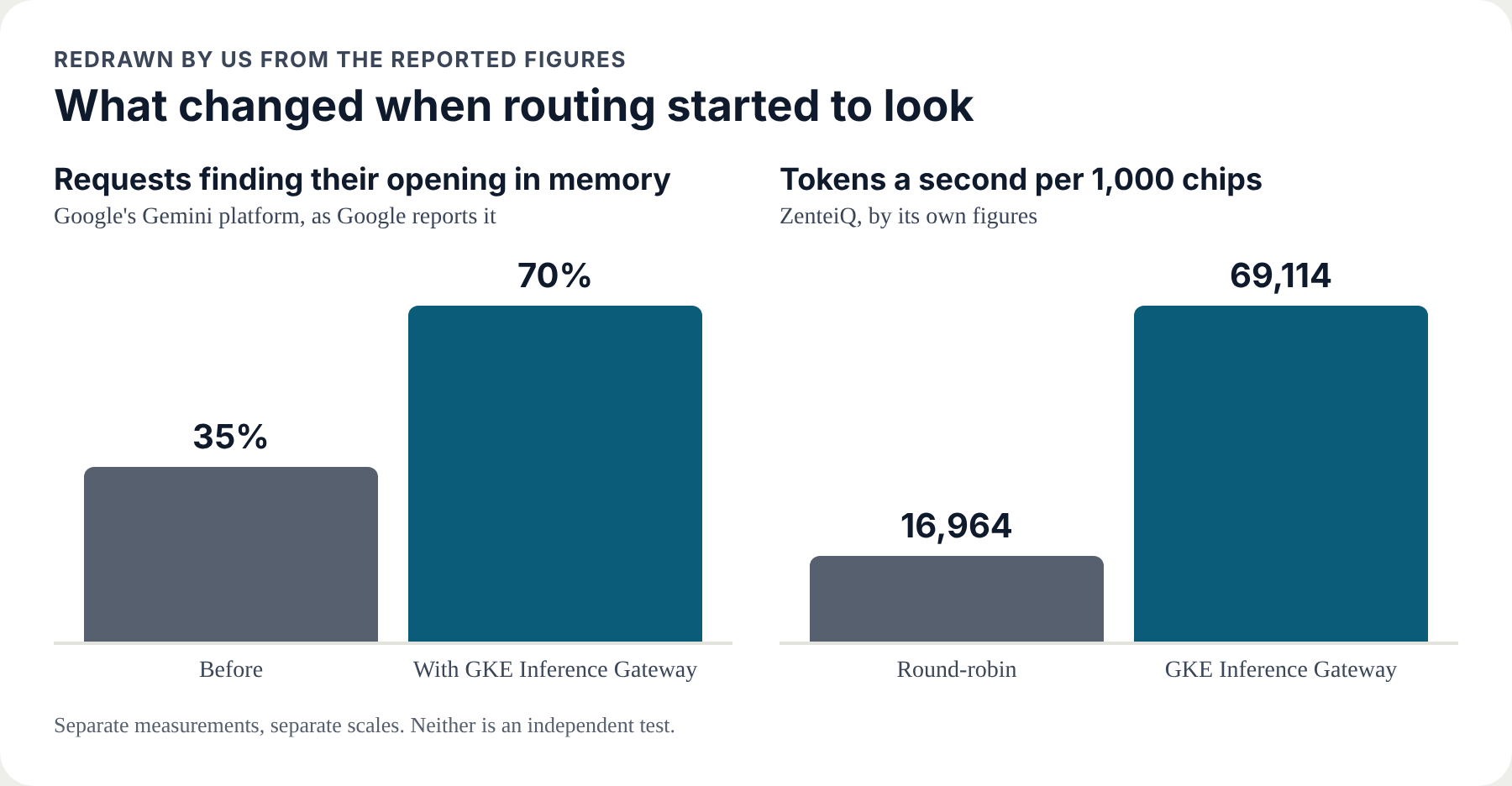
The fix changed no chip and no model: a load balancer that looks first, GKE Inference Gateway, went in front of the same servers. ZenteiQ reports 69,114 tokens (word-pieces of text) a second per 1,000 chips against 16,964 before: 4.07× the output, or 5.97 billion tokens a day instead of 1.47 billion.
Join free to read the rest
Join free to score your team, see what to check before you bet on it, get the first moves step by step, and learn how you'll know it's working.
Is it for you?
Should you change how requests are split?
Whoever runs your AI servers answers for the team
1Do you run your own or an open model on your own GPUs or TPUs?
vLLM on rented cloud GPUs, not a paid AI service
The splitting is yours to change.
2Do many requests start with the same long text?
one system prompt, a policy manual or a task template
Prefix-aware routing has repeated work to save.
3Do you run several servers for the same model?
two or more vLLM servers behind one address
Every request is a choice the load balancer can get right or wrong.
4Do answer lengths vary a lot?
short replies mixed with long reasoning
Load-aware routing stops queues jamming behind long answers.
5Do you run, or could you run, on Kubernetes?
GKE for the managed gateway; another cluster for llm-d
The router fits in front of what you already run.
Five yes answers is the position ZenteiQ was in. The scoring is ours.
Before you bet on it
How much faster is GKE Inference Gateway than round-robin?
4.07× tokens a second: 16,964 to 69,114 per 1,000 chips
ZenteiQ, reported by IT Brief and Google Company-reported; no independent test
3.5× to 5.5× per model pool
ZenteiQ Company-reported
14 points more requests finding instructions in memory
ZenteiQ Company-reported
Cache hits 35% to 70% on Gemini
Google, on its own platform Vendor-reported
2.4× throughput on an agentic coding load
Google, on Ironwood TPUs, with memory offload too Vendor test; not routing alone
Your first moves
Measure what you would save
-
Count how much your requests repeat
You should see: A long shared opening on most requests means prefix-aware routing has work to save; ZenteiQ's shared 70–80%.
Take a day of requests to one model and check what share of each opens with the same text: system prompt, template or manual. For example, a support bot whose questions all carry one policy document repeats everything but the question.
-
Check how uneven your servers are
You should see: Big gaps between servers mean load-aware routing has work to do.
Compare how busy each server is during a busy hour, and how much answer lengths vary. For example, one server finishing a long reasoning answer while three others sit idle.
Put the gateway in front of one pool
-
Check the cluster can take it
You should see: The cluster accepts the new resource types in the next step.
GKE 1.32.3 or later, VPC-native, with the HttpLoadBalancing add-on and a proxy-only subnet in the region. The Compute Engine, Kubernetes Engine and Network Services APIs must be on.
-
Install the resource types
You should see: kubectl get pods shows your vLLM servers running.
These teach Kubernetes what an InferencePool and the Endpoint Picker are. Then deploy vLLM from the llm-d guide; Google's example serves Llama 3.1 8B on H100 GPUs.
Show the command
kubectl apply -k "https://github.com/kubernetes-sigs/gateway-api-inference-extension/config/crd?ref=${GAIE_VERSION}" -
Create the pool and the picker with Helm
You should see: kubectl get inferencepool lists your pool.
Before running it, set
inferencePool.modelServers.matchLabelsinbase.values.yamlto your own servers' labels, and replaceLLM_D_REGISTRY_PATHwith the chart's address (Google's example:registry.k8s.io/gateway-api-inference-extension/charts/inferencepool).Show the command
helm install ${GUIDE_NAME} \ -f guides/recipes/scheduler/base.values.yaml \ -f guides/${GUIDE_NAME}/scheduler/${GUIDE_NAME}.values.yaml \ --set provider.name=gke \ --set inferenceExtension.monitoring.gke.enabled=true \ -n ${NAMESPACE} \ --version ${GAIE_VERSION} \ oci://LLM_D_REGISTRY_PATH -
Add a Gateway and a route
You should see: kubectl get inferenceobjective lists your objectives.
A Gateway of class gke-l7-regional-external-managed or gke-l7-rilb, and an HTTPRoute whose backend is the InferencePool. Optional InferenceObjective resources give each kind of traffic its priority.
-
Send one test request
You should see: HTTP 200 and an answer; any other status is an error.
This is Google's example. Our note: its single quotes stop the access token being filled in, so use double quotes on the Authorization line.
Show the command
curl -i -X POST ${IP}:${PORT}/v1/completions \
-H 'Content-Type: application/json' \
-H 'x-gateway-inference-objective: food-review' \
-H 'Authorization: Bearer $(gcloud auth application-default print-access-token)' \
-d '{
    "model": "food-review-1",
    "prompt": "What is the best pizza in the world?",
    "max_tokens": 2048,
    "temperature": 0
}'
Send the same requests both ways
-
Run one real job through each load balancer
You should see: Your gain depends on how much your requests repeat; ZenteiQ reported 4.07× and 14 points more cache hits.
Same servers, the same set of requests, similar load. Compare tokens a second, the share of requests that found their instructions in memory, and how long the job took.
-
Move live traffic over in stages
You should see: Latency and errors match or beat round-robin at each share.
The HTTPRoute can split traffic by weight or send a copy of it, so give the gateway a share first and grow it while the numbers hold.
How much does GKE Inference Gateway cost?
No additional cost; you pay for the Google Cloud resources it uses
Open source
Unchanged: the same servers
Not published
Google's documentation gives no other price.
How you'll know
What to watch
Dashboards: request rate, delays, errors and how full the servers are (Cloud Monitoring); the picker's numbers (Managed Service for Prometheus)
Good signMore cache hits and similar queue lengths across servers
Limits: 8 target ports per pool, 50 network endpoint groups per backend service, no retries for streaming answers
Good signNo surprises as you add servers
Refusals under pressure: requests marked below zero priority go first
Good signNo refusals for traffic you did not mark low priority
Under the hood
A model server is a machine with GPUs or TPUs that holds a copy of your model and answers requests. vLLM is the open-source software that runs on it, writing each answer a token (a word-piece) at a time.
What is LLM load balancing?
What is prefix caching in vLLM?
Every answer starts by reading the whole request, a step called prefill. The server can keep the result in its memory, a prefix cache, so a later request with the same opening skips straight to its question.
Why is round-robin load balancing bad for LLM inference?
With several servers, a load balancer picks one for each request. On Kubernetes the default is round-robin: it hands requests out in turn and sees nothing inside the servers.
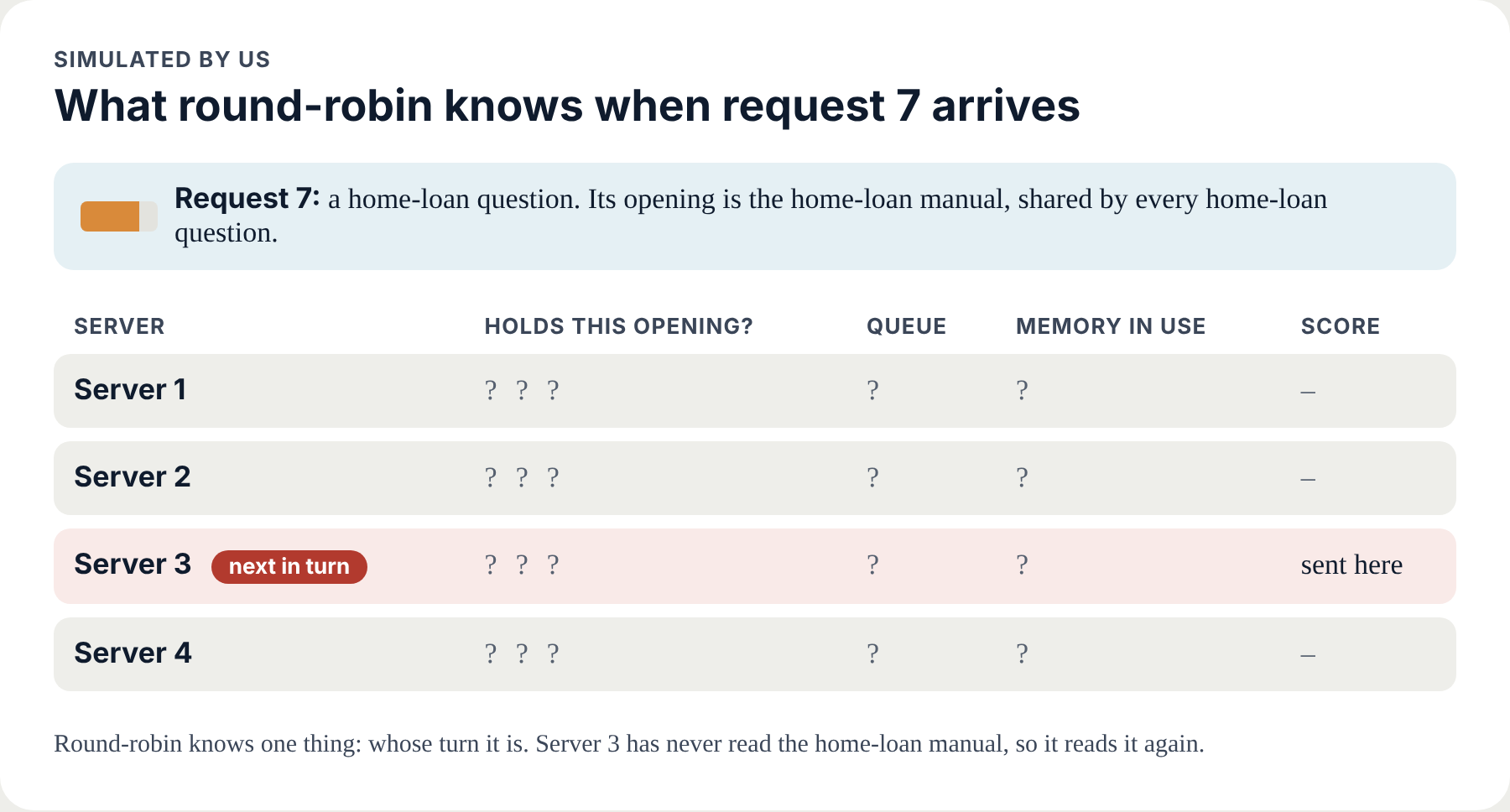
One request's path with round-robin
A request arrives: shared instructions plus one question
At ZenteiQ about 70–80% of each request was the same instructions.
Sources: [1]
The fix and its methods
The fix: a router that looks before it sends
Follow one request. It reaches the gateway (Google's managed version of llm-d, an open-source router), which asks a small service, the Endpoint Picker, where to send it. The picker scores every server on its memory and how busy it is.
The scoring runs by itself on every request, from numbers the servers report live. You set which servers form the pool, which models it serves and, if you want, a priority for each kind of traffic.
Method 1, prefix-cache-aware routing: send each request where its instructions are
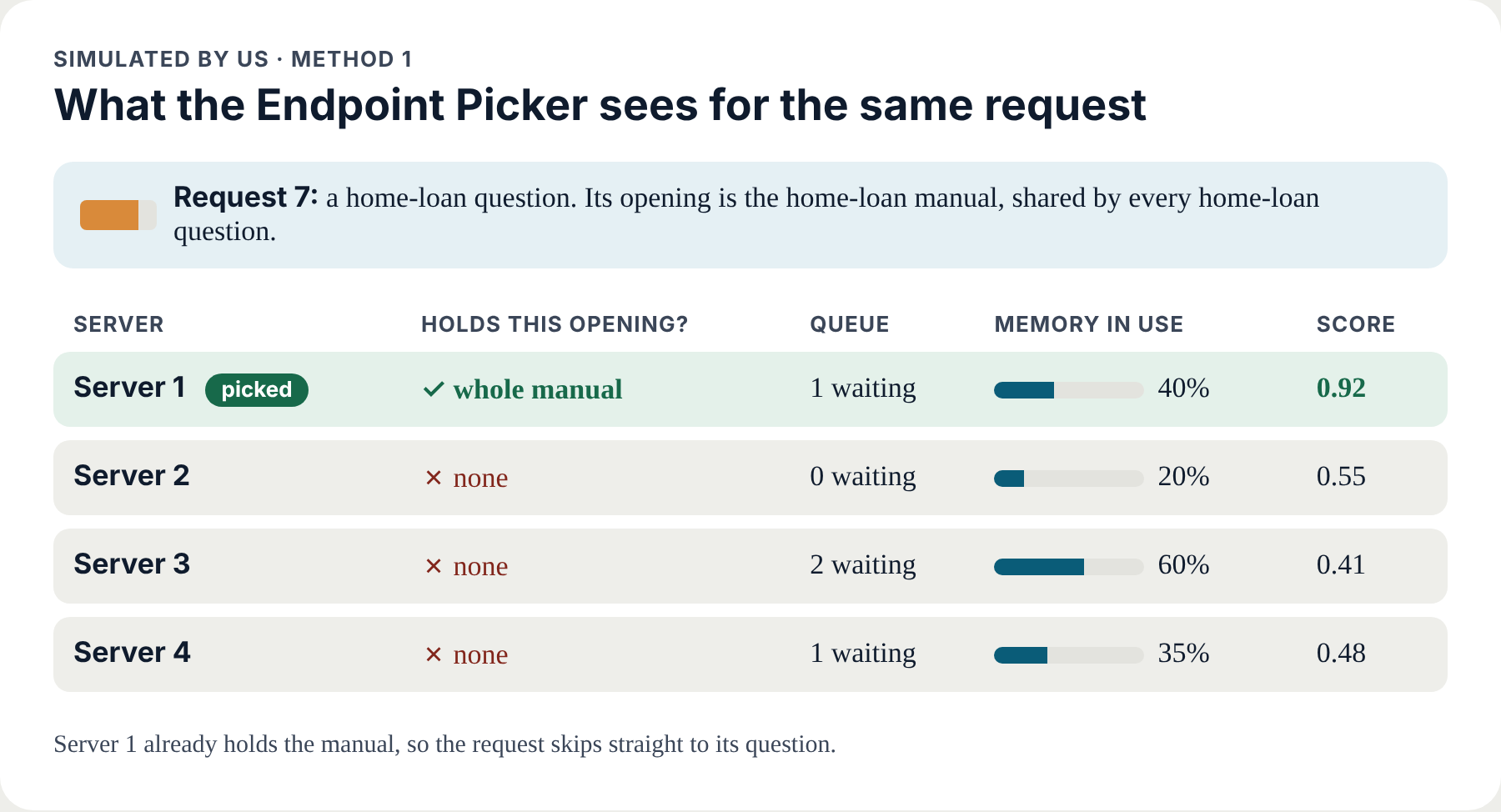
The picker tracks which opening text each server holds and scores a longer match higher (prefix-cache-aware routing). At ZenteiQ, 14 percentage points more requests found their instructions already in memory.
Method 2, load-aware routing: check who is busy
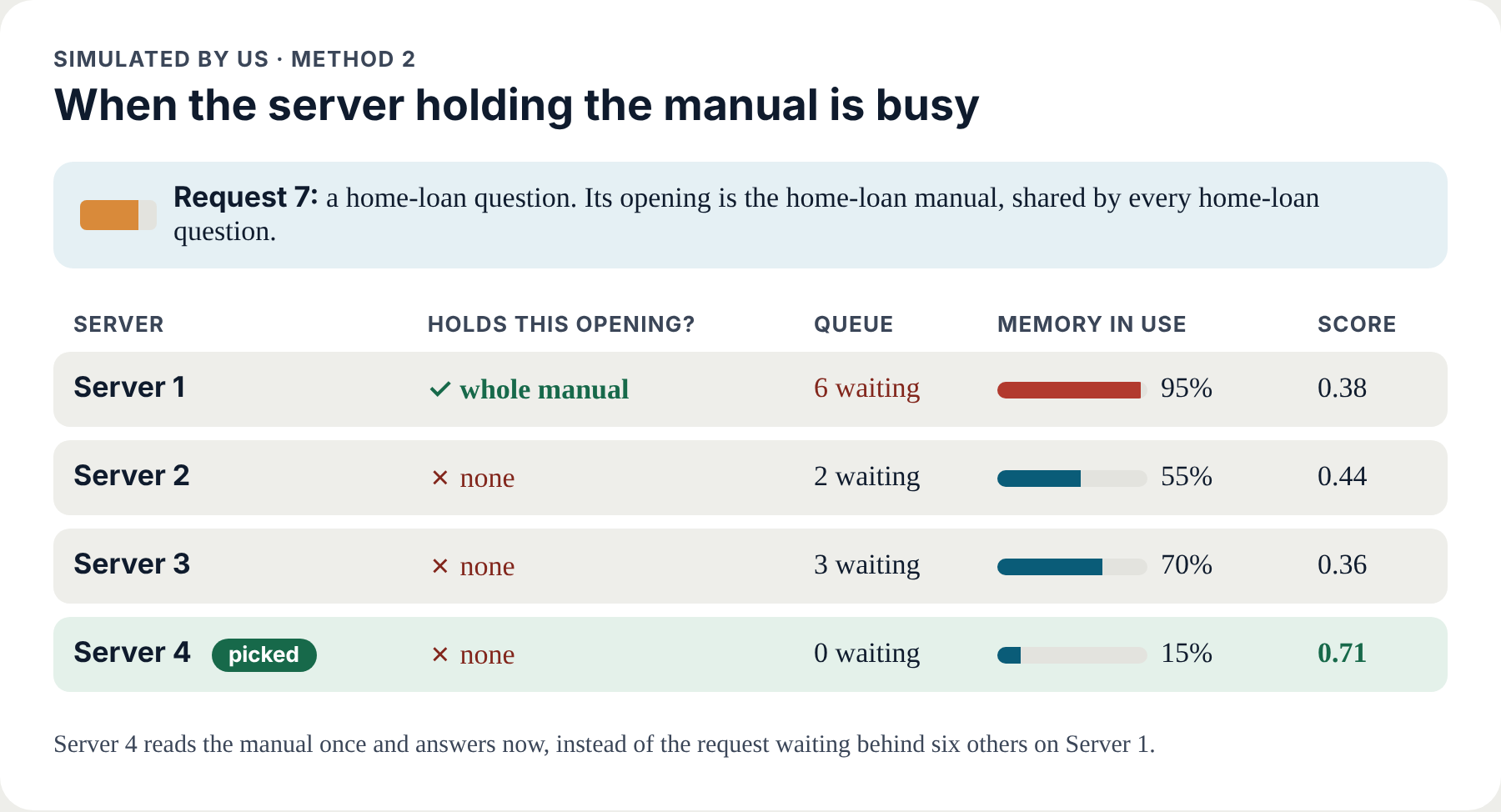
The picker also reads each server's queue length and how full its memory is (load-aware routing). ZenteiQ's model pools each ran 3.5 to 5.5 times faster, and one gateway now serves its 9-billion- and 35-billion-parameter models together.
Two more things the sources answer. Each kind of traffic can carry a priority, so live chat can go ahead of overnight bulk work; ZenteiQ did not say it used this. The shared text stays in each server's own memory until needed for other work; the sources give no time.
Why not just add more servers for LLM inference?
Add more servers
What it fixesMore capacity
What it leavesEach new server re-reads the same instructions; queues stay uneven
Keep round-robin, tune each server
What it fixesFaster single servers
What it leavesThe load balancer still scatters similar requests
A router that looks first
What it fixesRepeated work and uneven queues
What it leavesThe managed version needs GKE; elsewhere you run llm-d yourself
Sources
Check our working
- IT Brief: ZenteiQ boosts inference throughput with Google Gateway (5 Nov 2026)
- Google Cloud blog: Announcing llm-d 1.0 (20 Oct 2026)
- Google Cloud: About GKE Inference Gateway
- Google Cloud: Deploy GKE Inference Gateway
Found this useful? Send it to someone who should read it.