What the law expects
How a scam gets Booking.com's own name, and what the law asks instead
A hotel on Booking.com logs in to a partner account. Behind that login sits every upcoming guest: names, dates, and a chat that delivers messages in Booking.com's app. With the hotel's password, a stranger can write to all of those guests, through Booking.com itself.
That is what security researchers found. Secureworks, a security firm, traced one case to malware on a hotel computer that stole its saved passwords. The security company Gen Digital counted more than 350 hotels whose Booking.com logins were hijacked, in 50 countries, by May 2026.
The guest's usual checks all pass. The sender is real, the app is real, the booking is real. Only the request to pay again is fake.
Taking down one account does not end it, because the next stolen password works the same way. So the law asks a different question. Did the platform check how its guest data and chat could be misused, and act on what it found? That is the question the Commission is now asking Booking.com.
The scam message really comes from Booking.com
Tap Next to follow one scam from the first email to the stolen money.
Emails the hotel: "I lost my passport."
Pretends to be a past guest. The first email has no link, so spam filters let it through. A second one sends "passport photos".
Sources: [5] [6] [7] [1]
Why now
On 21 October the Commission opened its case against Booking.com; five days later it accepted Temu's fix plan. That plan is the first public list of what the EU expects a platform to measure in its own systems.
If hotels or sellers can reach your customers, make 2-step login (a password plus a code from a phone) compulsory for them. Then build your next yearly risk report from your own data, using Temu's accepted plan as the checklist.
Join free to read the rest
Join free to unlock: who has to do what, the timeline and steps to comply, what is at stake if you don't, and where this paper falls short.
Does it apply to you?
Does the Digital Services Act apply to my platform?
Check your platform in under a minute. Answer for your own company. The meter moves with every answer.
What to do
The fix, by deadline
Step by step, with who does each one.
Timelines to finish
- Already
The law has applied to every platform since 17 February 2024; the yearly risk report applies only to the largest
- Now
Booking.com's case is open. It can end with fixes Booking.com promises and the Commission accepts, or with a ruling that it broke the law
- 2027, around February
Temu must have the five fixes in its plan in place, four months after 26 October (our count). The five are in the Commission's release: use them as your checklist
- 2027, around June
An outside auditor's report on Temu's fixes is due (our count). Our view: other large platforms will be measured against what that audit accepts
Close the scam route
By Friday, a stolen password should no longer let anyone message your customers as a hotel or seller.
-
CTOMake 2-step login compulsory on every partner account
You should see: A login attempt with only the password is refused
A hotel or seller logs in with a password plus a code from their phone. A password copied by malware is then not enough on its own. Secureworks, the security firm that investigated one hijacked hotel account, says this would likely stop most such break-ins.
-
ProductStop payment requests travelling through the chat
You should see: A test message with a payment link is flagged before it reaches the customer
Flag or block messages that ask for card details or carry payment links. Tell customers in the app that you never ask for cards by message, as Booking.com does.
-
CTOAlert on bursts from new devices
You should see: Log in from a new device and send 25 test messages: an alert fires
In the Secureworks case, the hijacked hotel account messaged upcoming guests the day after the break-in. Alert when an account logs in from a new device and then messages more than, say, 20 customers within an hour. Tune the number to your normal traffic.
Measure your own system
By your next yearly risk report (the largest platforms file one every year), every number in it comes from your own platform.
-
Trust & safetyRebuild the risk report from your own data
You should see: Every risk figure in the report names the platform data it comes from
Use your own complaints, takedowns and test purchases, not industry averages. This is the first measure in Temu's accepted plan.
-
CTOMeasure what the feed amplifies
You should see: A monthly number: views of removed items, per thousand feed views
For items later removed as unsafe or fake, count how many times the feed showed them before removal.
-
LegalCheck every paid placement carries an ad label
You should see: A boosted listing shows an ad label, who paid, and a "why am I seeing this" link with the main reasons
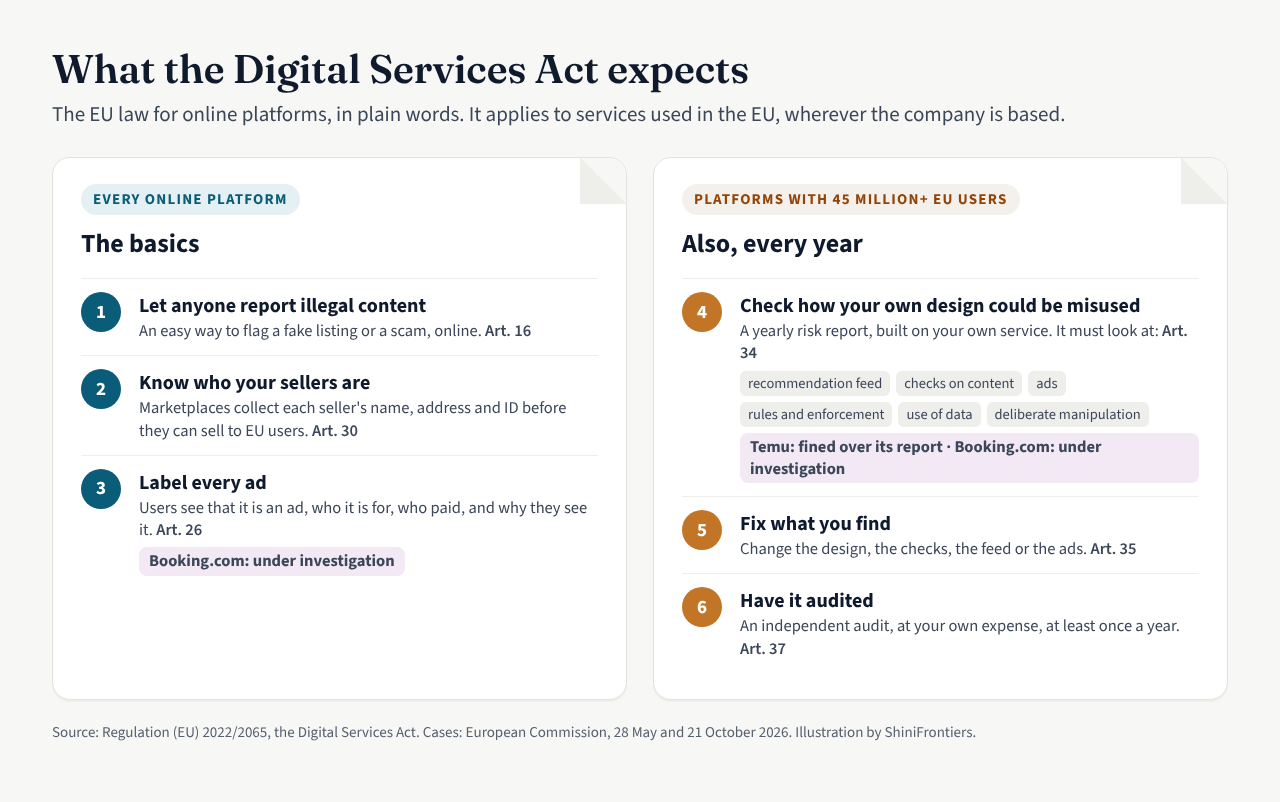
Article 26 of the Digital Services Act says a user must see, for each ad, that it is an ad and who it is for. They must also see who paid, and the main reasons it is shown to them.
How much does Digital Services Act compliance cost?
No price in the sources
No price in the sources
Business impact
What would have reduced the impact
Business impact of not completing
| If you don't | What it can cost |
|---|---|
| Keep a risk report built on industry-wide figures, as Temu did | A fine of up to 6% of worldwide yearly turnover (Article 74 of the Digital Services Act); Temu's was €200 million |
| Leave the fix to the regulator | A plan on the Commission's terms, with deadlines and an outside audit, as Temu now has |
| Let hotels or sellers log in with a password alone | Your own app delivers the scam, so customers stop trusting your messages |
| Leave paid rankings unlabelled | A breach of Article 26 of the Digital Services Act: every platform must label each ad and say who paid |
What does Digital Services Act compliance get the business?
| Done | What you get |
|---|---|
| Risk report from your own data | Numbers you can show the regulator, and an early warning of what your feed spreads |
| Compulsory 2-step login | A stolen password no longer reaches your customers |
| Payment requests kept out of chat | The scam's last step, the fake payment page, stops working |
Under the hood
What does the Digital Services Act require platforms to check?
Article 34 of the Digital Services Act lists what the biggest platforms' yearly risk report must look at. It names the recommendation feed (the software choosing what each user sees) and the checks on listings. It also names the ad systems, the platform's rules, and how it uses data. And it asks how people could deliberately manipulate the service. These are engineering systems, so the cases test how a platform is built, not what one seller did.
One unsafe charger, round Temu's loop
Tap Next: from seller to shopper, and round again
A seller lists a cheap phone charger.
In the EU's test purchases on Temu, a very high share of the chargers failed basic safety tests.
What a lab finds inside a charger
Inside every charger, the wall's 230 volts sit right next to the 5 volts going to your phone. Only a gap keeps them apart.
Wide gap: the 230 volts can't jump across.
Which?, a UK consumer group, tested 15 chargers from seven marketplaces in June 2026. Its few Temu chargers passed but lacked required markings. A small test can miss what a large one finds: the EU's larger test found a very high share failing.
Sources: [2] [3] [8]
Why is taking listings down not enough under the Digital Services Act?
A takedown fixes one item; the next unsafe charger or stolen login arrives the same way. The law still shields a platform from liability for content it didn't know about (Article 6). So the Commission fined Temu not for any listing, but for a yearly risk report that never measured how its feed and promoters spread them.
What we don't know yet
Limits, and what would change our mind
What the sources leave open, and how to act anyway.
What would change our mind
The Commission closes the Booking.com case with no change to how hotels log in or to the chat.
Temu's audit is accepted without any measure of what its feed amplifies.
Security firms report that hijacked hotel accounts keep messaging guests even after 2-step login becomes compulsory.
Sources
Check our working
- European Commission: Commission to investigate how Booking.com combats scams and fraud under the Digital Services Act (21 Oct 2026)
- European Commission: Commission fines Temu €200 million for breaching the Digital Services Act (28 May 2026)
- European Commission: Commission accepts Temu's corrective measures (26 Oct 2026)
- Regulation (EU) 2022/2065, the Digital Services Act (Articles 2, 6, 26, 33, 34, 35, 74, 93)
- Secureworks Counter Threat Unit: Vidar infostealer steals Booking.com credentials in fraud scam
- Microsoft Threat Intelligence: Phishing campaign impersonates Booking.com, delivers a suite of credential-stealing malware (13 Mar 2025)
- Gen Digital: When hotel scams know your booking: 350 compromised accommodations across 50 countries (28 May 2026)
- Which?: Phone chargers sold on Amazon Haul, B&Q and eBay can electrocute and explode (11 Jun 2026)
- European Commission: list of designated very large online platforms (updated 6 Nov 2026)
Found this useful? Send it to someone who should read it.